
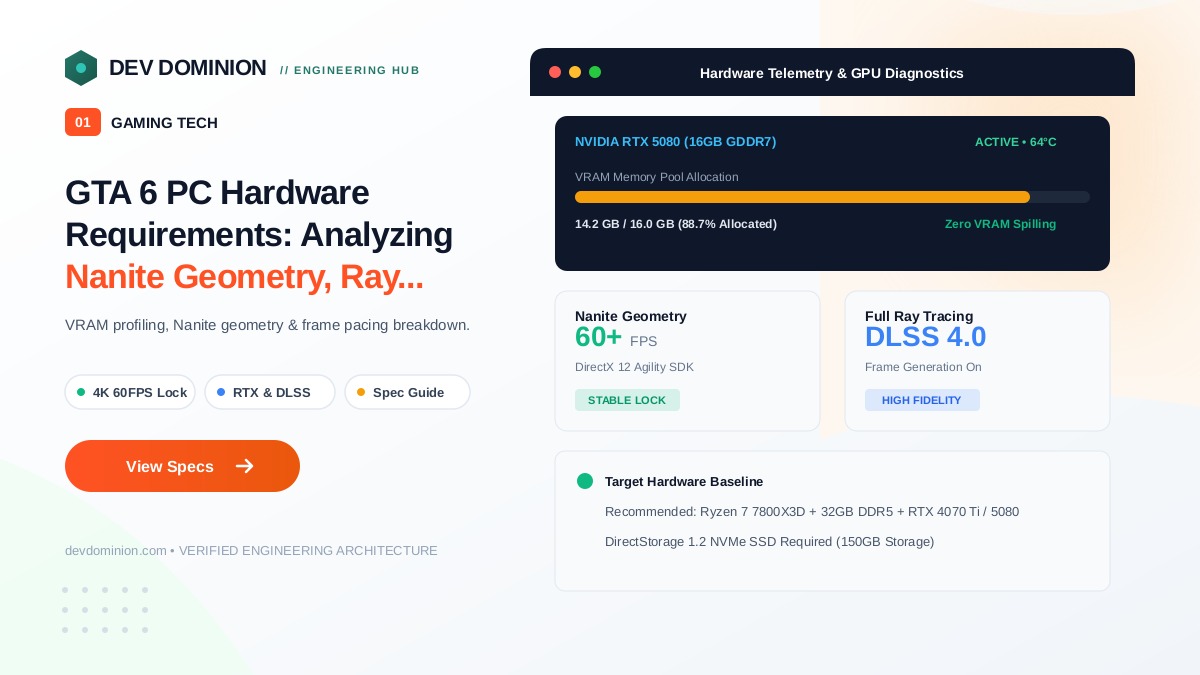
GTA 6 PC Hardware Requirements: Analyzing Nanite Geometry, Ray Tracing, and Anticipated System Specs
Deconstructing the Next Generation of Open-World Rendering
As Rockstar Games prepares for the anticipated PC launch of Grand Theft Auto VI, the technical specifications required to drive Vice City at native fidelity represent a generational leap in desktop hardware demands. Drawing from official console telemetry and Rockstar’s latest patent filings for volumetric cloud simulation and AI pathfinding, we break down what PC enthusiasts must prepare for.
1. Ray Traced Global Illumination (RTGI) as a Baseline
Unlike GTA V, which relied heavily on baked lightmaps and screen-space reflections, GTA 6 is engineered with continuous real-world lighting. Nighttime in Vice City—dominated by neon signage reflecting across rain-slicked asphalt—demands dedicated BVH (Bounding Volume Hierarchy) hardware traversal.
- Minimum Spec: GeForce RTX 3060 (12GB) or Radeon RX 6700 XT for 1080p @ 30-45 FPS with hardware upscaling.
- Recommended 1440p Target: GeForce RTX 4070 Super or Radeon RX 7900 GRE to sustain 60 FPS with Ray Traced reflections enabled.
- Ultra 4K Enthusiast: GeForce RTX 4080 / RTX 5080 with DLSS Frame Generation active.
2. The VRAM Reality: 16GB is the New Standard
With photogrammetric asset streaming and ultra-high-resolution texture mipmaps for dense urban crowds and dynamic foliage, 8GB VRAM graphics cards will inevitably experience asset pop-in and texture budget throttling. Modern direct-storage API utilization requires at least 12GB to 16GB of dedicated VRAM for uncompromised asset streaming.
3. CPU Thread Allocation: Physics, AI, and Traffic Densities
Vice City’s biological and vehicular density places unprecedented strain on the host CPU. Rockstar’s machine-learned traffic routines and dynamic pedestrian behaviors necessitate an 8-core / 16-thread modern processor (AMD Ryzen 7 7800X3D or Intel Core i7-14700K) to eliminate frame pacing stutter in downtown districts.